President Obama's "Sunlight before Signing" pledge, in which he promised to post all new legislation online and wait five days before signing it in order to give Americans a chance to review it, was a promise empty of any real meaning. With no expectation that this policy would affect whether or not the president signs a bill, it matters not whether the "viewing period" comes before or after the actual signing. It seems clear that the promise was purely a political one, a nod to "transparency" with no tangible effect.
Still, it's disappointing that Obama has been unable to keep even his token promise. At a time when trust in government is fragile, the breaking of even a vacuous promise -- possibly especially a vacuous promise -- isn't helpful.
What would be helpful, in terms of both transparency and trust, would be to build some meaningful delays into the legislative process. Congress has become increasingly irresponsible in its willingness to rush through pieces of legislation without due deliberation. We saw this with the "stimulus" bill, where legislators were forced to vote on a 1000-plus page bill to cost taxpayers $787,000,000,000 within a few hours of its becoming available to them.
This was clearly done for political reasons. Polls showed that the more the public learned about the bill, the less they supported it. Democrats had to ram it through before we figured out what was in it. Three months later, we're still being surprised by what is in it, and how ill-conceived it was.
The Democrats were properly criticized for not allowing enough time for reams of legalise to be read (let alone digested, considered, and debated) before forcing a vote. Their response was to hire speed readers to read subsequent bills into the record. This is what passes for responsible government in our nation's capital.
The handling of the cap-and-trade bill, passed by the House yesterday is an even more egregious example. In this case it wasn't merely a matter of not allowing the time to read a bill, but the fact that there was no actual bill to read. Apparently, the only "copy" of the bill was two separate stacks of paper, the first being a 1000-plus page earlier draft of the "bill," the second being a 300-page "amendment," comprised of statements which take the form: "Page 15, beginning line 8, strike paragraph (11)..."
It's outrageous that our government is enacting a massive energy policy that will cost over $1,000,000,000,000 in this reckless manner. Even the most trivial of laws should deliberated upon. That it has become commonplace for $1,000,000,000,000 bills to be slapped together in this way is beyond irresponsible; it is obscene. Any member of Congress who voted for this bill should be removed from office for malfeasance and violation of the public trust.
If Obama wants to do something meaningful in the area of transparent and responsible government, he should be pushing Congress to enact some meaningful policies which ensure that all bills that come before his desk have been well researched, well considered, and well debated. These are not unreasonable requirements. This is what our representatives are elected for. It is their job to know what they are voting on, and it's sickening that that they can't be trusted to do it.
[h/t Andy McCarthy, Powerline]
Sunday, June 28, 2009


Friday, June 26, 2009
High cost of government schools
Andrew Coulson reports that Washington D.C. spends over $27,000 per student on public education. Meanwhile, the tuition in D.C. private schools averages $6,600 per student, and those students read two grade levels ahead of their public school peers.
Wednesday, June 24, 2009
Having it Both Ways
Washington Post:
Obama's approach to Iran, including his assertion that the unrest there represents a debate among Iranians unrelated to the United States, is an acknowledgment that a U.S. president's words have a limited ability to alter foreign events in real time and could do more harm than good. But privately Obama advisers are crediting his Cairo speech for inspiring the protesters, especially the young ones, who are now posing the most direct challenge to the republic's Islamic authority in its 30-year history.Obama has justified his timid and tardy response to the violence in Iran as an attempt to avoid being seen as meddling. He has also complained that the Iranian mullahs have mistranslated his remarks in order to falsely claim that America incited the protests there. Yet here we have Obama's advisers boasting of his doing exactly that which he denies.
Prison Rape
Given the prevalence of prison rape, it seems to me that the mere sentencing of someone to incarceration amounts to cruel and unusual punishment. It's an uncomfortable subject, but I've always wondered why this gets so little attention.
I hope these efforts to alleviate the problem are successful.
[h/t: Eli Lehrer]
I hope these efforts to alleviate the problem are successful.
[h/t: Eli Lehrer]
Beginning of a Trend?
Arizona will be voting on a proposition which will protect residents from being forced to participate in government-run health care plans.
I wonder if we'll see other states following suit.
The Healthcare Freedom Bill provides for two fundamental rights:As always, I'm astounded that such a law is necessary. The notion that government can hold a gun to your head and force you to participate in a health care program that you don't want is a fundamental violation of freedom. It makes no sense that a state should have to pass a law to prevent government from doing something it doesn't have the authority to do in the first place.
- The right to spend your own money to seek out and receive health care services that are otherwise legal.
- The right to choose NOT to participate in any health care system, of any type.
I wonder if we'll see other states following suit.
Tuesday, June 23, 2009
Hot Dog Diplomacy
From an AFP report: [emphasis mine]
Indefensible. Damn, I miss George Bush.
Update:
The United States said Monday its invitations were still standing for Iranian diplomats to attend July 4 celebrations at US embassies despite the crackdown on opposition supporters.So while Iranian mullahs are beating and killing their own people for holding peaceful protests of a blatantly rigged election, the U.S. is throwing a wienie roast for them as a "gesture of goodwill."President Barack Obama's administration said earlier this month it would invite Iran to US embassy barbecues for the national holiday for the first time since the two nations severed relations following the 1979 Islamic revolution.
"There's no thought to rescinding the invitations to Iranian diplomats," State Department spokesman Ian Kelly told reporters. . . .
The State Department has said that the invitations are largely a symbolic gesture of goodwill and that the July 4 barbecues were not intended to take up substantive policy matters.
Indefensible. Damn, I miss George Bush.
Update:
The White House has rescinded the invitations to Iranian diplomats to attend July 4 celebrations at U.S. embassies around the world.Again, Obama comes around, but only after getting cornered on this issue at yesterday's press conference. Another case of too little, too late -- "leading" by bringing up the rear.
White House press secretary Robert Gibbs said nobody from Iran RSVPed to come, and at this point, the invitations are no longer valid. "
Given the events of the past many days, those invitations will no longer be extended," Mr. Gibbs said.
Leader Prevaricator of the Free World
There's been a lot of discussion about what the proper response should have been from President Obama to the recent election in Iran and the protests and violence that followed. I come down on the side of those who believe the president's response was both timid and tardy. I wasn't looking so much for hard language as I was moral clarity.
Obama defended his approach by saying that he didn't want to be seen as taking sides, and that it is up to the Iranian people to determine their country's course. This would make sense if Iran wasn't under the control of an oppressive regime, if it held free elections, and if its people were actually able to choose their destiny. The reality of the situation, however, is just the opposite: the Iranian government is brutally oppressive, its elections are blatantly rigged, and its people are being beaten and killed in the streets in response to their peaceful protests.
So Obama should be taking sides -- not in so much as to be choosing winners and losers, but he should be standing clearly on the side of freedom, democracy, and fundamental human rights -- the things, as JFK put it, "to which this Nation has always been committed, and to which we are committed today at home and around the world."
Obama often stresses the important of remaining true to America's values, yet he's been hesitant to state those values clearly and openly. He says it's because he fears such words would be used to blame America for the conflict in Iran. This is belied by his admission that, even in the absence of such words, the Iranian regime has simply lied about Obama's statements and accused America of inciting the protests anyway.
Obama certainly has the rhetorical skills to provide clarity and leadership, yet he chooses not to, instead favoring a more "neutral" stance. But neutrality is vice in the face of evil, and what Obama offers is neutrality in name only.
While giving a most feeble voice to the principles of liberty and human dignity, Obama flatly proclaimed that it doesn't matter who emerges as the victor in Iran, and that the United States is just as willing to sit at the table with the murderous mullahs as it is with those who are risking their lives to throw off the yokes of oppression. These statements are not only an abdication of American values, they are a betrayal of those who value the freedoms we hold dear and are willing to die for them. Obama's statements are a de facto endorsement of the status quo.
It's all good, he says. No price worth paying, no burden worth bearing, no hardship worth meeting, no friend worth supporting here. Just let us know when you've sorted it out, and its back to business as usual.
It is good to see that Obama has come around to some extent. He's beefed up his rhetoric of late, pressured and embarrassed by the fact that France, Germany, and both houses of Congress have displayed a truer moral compass than his own.
Better late than never? Or too little, too late? Either way, it's a sad thing when the "leader of the free world" is unwilling to show leadership in the cause of freedom.
Obama defended his approach by saying that he didn't want to be seen as taking sides, and that it is up to the Iranian people to determine their country's course. This would make sense if Iran wasn't under the control of an oppressive regime, if it held free elections, and if its people were actually able to choose their destiny. The reality of the situation, however, is just the opposite: the Iranian government is brutally oppressive, its elections are blatantly rigged, and its people are being beaten and killed in the streets in response to their peaceful protests.
So Obama should be taking sides -- not in so much as to be choosing winners and losers, but he should be standing clearly on the side of freedom, democracy, and fundamental human rights -- the things, as JFK put it, "to which this Nation has always been committed, and to which we are committed today at home and around the world."
Obama often stresses the important of remaining true to America's values, yet he's been hesitant to state those values clearly and openly. He says it's because he fears such words would be used to blame America for the conflict in Iran. This is belied by his admission that, even in the absence of such words, the Iranian regime has simply lied about Obama's statements and accused America of inciting the protests anyway.
Obama certainly has the rhetorical skills to provide clarity and leadership, yet he chooses not to, instead favoring a more "neutral" stance. But neutrality is vice in the face of evil, and what Obama offers is neutrality in name only.
While giving a most feeble voice to the principles of liberty and human dignity, Obama flatly proclaimed that it doesn't matter who emerges as the victor in Iran, and that the United States is just as willing to sit at the table with the murderous mullahs as it is with those who are risking their lives to throw off the yokes of oppression. These statements are not only an abdication of American values, they are a betrayal of those who value the freedoms we hold dear and are willing to die for them. Obama's statements are a de facto endorsement of the status quo.
It's all good, he says. No price worth paying, no burden worth bearing, no hardship worth meeting, no friend worth supporting here. Just let us know when you've sorted it out, and its back to business as usual.
It is good to see that Obama has come around to some extent. He's beefed up his rhetoric of late, pressured and embarrassed by the fact that France, Germany, and both houses of Congress have displayed a truer moral compass than his own.
Better late than never? Or too little, too late? Either way, it's a sad thing when the "leader of the free world" is unwilling to show leadership in the cause of freedom.
Charter schools in name only
It's well established by now that charter schools are a success. Students who attend them do better than their counterparts in traditional government schools, and parents with kids in charters are much more satisfied. There is even evidence that traditional public schools benefit from the competition charters provide.
Assuming that liberals don't kill the charter movement, as they are attempting to do in Michigan and Washington D.C., the key question becomes whether the charter philosophy can be expanded to act as a model for all of public schooling. I strongly believe that it can't, because those who wield power -- "educrats" and their union allies -- won't allow it. Once it becomes clear to them that the public is rallying behind charters, those who control traditional schools will embrace the charter movement, assume power, then proceed to devolve charters back into something that looks very much like the public schools system that dis-serves us now.
Andrew Coulson blogs about this phenomenon on the Cato blog, stating, "If you want to know what charter schools will look like in a generation or so, just look at the public school status quo."
The defining characteristic of charters is a greater degree of autonomy. Charter school principals have much more freedom over how their schools operate. They have control over such things as hiring and firing practices, school scheduling, and discipline. These are the things that make a school work. And these are the very things the Obama administration and the teachers union are steadily working to undermine.
The proposed new restrictions, regulations, and oversight will strip away the things that allow charters to succeed. At that point, they will be charter schools in name only, and those who have worked to destroy them will credibly be able to argue that they have failed.
Assuming that liberals don't kill the charter movement, as they are attempting to do in Michigan and Washington D.C., the key question becomes whether the charter philosophy can be expanded to act as a model for all of public schooling. I strongly believe that it can't, because those who wield power -- "educrats" and their union allies -- won't allow it. Once it becomes clear to them that the public is rallying behind charters, those who control traditional schools will embrace the charter movement, assume power, then proceed to devolve charters back into something that looks very much like the public schools system that dis-serves us now.
Andrew Coulson blogs about this phenomenon on the Cato blog, stating, "If you want to know what charter schools will look like in a generation or so, just look at the public school status quo."
The defining characteristic of charters is a greater degree of autonomy. Charter school principals have much more freedom over how their schools operate. They have control over such things as hiring and firing practices, school scheduling, and discipline. These are the things that make a school work. And these are the very things the Obama administration and the teachers union are steadily working to undermine.
The proposed new restrictions, regulations, and oversight will strip away the things that allow charters to succeed. At that point, they will be charter schools in name only, and those who have worked to destroy them will credibly be able to argue that they have failed.
Monday, June 22, 2009
The Other Great Depression
I don't write much about my depression, mostly because it's, well, depressing. I think that others don't want to be brought down by it, and I don't want to come across as whining.
Another reason I don't write about my depression is because I don't think it's all that interesting. Yes, it consumes me. It is the single most defining characteristic of my life. It's with me all day, every day, and there is nothing that I do that is not in some way diminished by it. But what's there to say about it, especially when the precious energy required to say it could be put to better use?
Things have been particularly tough lately. In addition to the funk and all that goes with it, my depression is keeping me from doing the things I need to do to take care of my diabetes. I'm not exercising. I'm not eating well. I'm skipping medicines.
I know these behaviors will literally kill me, and make me suffer while I live. But even as my eyes continue to deteriorate, my kidneys fail, and I continue to lose sensation in my legs and feet, I lack the motivation to do the right things. The fact that my father lost his leg and his sight to diabetes, and the knowledge that I am accelerating toward that same end should light a fire under me, but it no longer does. It's damn frustrating, and I curse myself for it.
Blogging is my escape, for now. It's increasingly difficult to read, think, or write. But, out of fear, I try to keep my head down and plow ahead until I can find some other addiction to hide behind.
I used to like myself, but now I just feel damaged, and I don't at all like this thing that I've become. I know the fear and insecurity and anger have always been there, but I've been worn so far down that they now lay raw and exposed.
I've known for a while that I won't get better, but as I decline that knowledge gets harder to deal with. Yet that's who I am. That's what I do.
Another reason I don't write about my depression is because I don't think it's all that interesting. Yes, it consumes me. It is the single most defining characteristic of my life. It's with me all day, every day, and there is nothing that I do that is not in some way diminished by it. But what's there to say about it, especially when the precious energy required to say it could be put to better use?
Things have been particularly tough lately. In addition to the funk and all that goes with it, my depression is keeping me from doing the things I need to do to take care of my diabetes. I'm not exercising. I'm not eating well. I'm skipping medicines.
I know these behaviors will literally kill me, and make me suffer while I live. But even as my eyes continue to deteriorate, my kidneys fail, and I continue to lose sensation in my legs and feet, I lack the motivation to do the right things. The fact that my father lost his leg and his sight to diabetes, and the knowledge that I am accelerating toward that same end should light a fire under me, but it no longer does. It's damn frustrating, and I curse myself for it.
Blogging is my escape, for now. It's increasingly difficult to read, think, or write. But, out of fear, I try to keep my head down and plow ahead until I can find some other addiction to hide behind.
I used to like myself, but now I just feel damaged, and I don't at all like this thing that I've become. I know the fear and insecurity and anger have always been there, but I've been worn so far down that they now lay raw and exposed.
I've known for a while that I won't get better, but as I decline that knowledge gets harder to deal with. Yet that's who I am. That's what I do.
Government-run means more expensive
Jeffrey Anderson @ Investors.com:
The centerpiece of President Obama's plan is a "public option," described by Tom Daschle as "a government-run insurance program, modeled after Medicare." The president asserts that this new Medicare-like program would cut costs.But there are nearly 40 years of experience to consult, and they offer a resounding rebuttal. Across the years, Medicare's costs have risen far more than the costs of privately purchased care.
The article includes a nice graph of the growing gap between Medicare spending and non-Medicare spending.

Journalistic Malpractice
From a New York Times article whose headline proclaims "Wide Support for Government-Run Health" :
Not too surprising that Obama supporters would support an Obama policy, is it?
[h/t: Noel Sheppard]
Americans overwhelmingly support substantial changes to the health care system and are strongly behind one of the most contentious proposals Congress is considering, a government-run insurance plan to compete with private insurers, according to the latest New York Times/CBS News poll. . . .The problem? This is a dishonest poll. As Bruce Kesler discovered, the NYT poll surveyed twice as many people who voted for Obama than voted for McCain.
The national telephone survey, which was conducted from June 12 to 16, found that 72 percent of those questioned supported a government-administered insurance plan . . .
Not too surprising that Obama supporters would support an Obama policy, is it?
[h/t: Noel Sheppard]
Obama-care won't reduce health care costs
I'm not aware of evidence that savings would be realized from any of the things on Reich's list. Proponents of government-run health care make the claims, but real world examples suggest that costs will rise rather than fall. Just this morning, I heard a report on the massive rise in health care costs in Massachusetts. This is the plan which is to be used as a model for national health care, yet health care costs in Massachusetts have increased at twice the rate of the rest of the nation. The report also noted that the Massachusetts plan still leaves about 5% of the population uncovered. That extrapolates to about 15 million uncovered Americans if the Mass plan were scaled up to the national level.Momentum for universal health care is slowing dramatically on Capitol Hill. Moderates are worried; Republicans are digging in; and the medical-industrial complex is firing up its lobbying and propaganda machine.
But, as you know, the worst news came days ago when the Congressional Budget Office weighed in with awful projections about how much the leading health-care plans would cost and how many Americans would still be left out in the cold. Yet these projections didn't include the savings that a public option would generate by negotiating lower drug prices, doctor fees, and hospital costs, and forcing private insurers to be more competitive.
A public option may indeed lower drug prices, since a single-payer government could effectively put a gun to the head of the pharmaceutical companies. But, as Thomas Sowell so often points out, lowering the price of something doesn't change it's cost. A company whose profits are stripped away will be forced to downsize and cut back on research. This will cost jobs in the short term, and lives in the long term. There are no short cuts, just trade offs.
Forcing doctors to accept lower fees will have unintended consequences as well. We see evidence of this already with Medicare and Medicaid. Many doctors simply refuse to accept patients under these plans, since payouts often aren't enough to cover expenses. If a Medicare-type of system is forced onto the medical profession as a whole, we can expect to see fewer people entering the field and a rationing of the services offered.
That government-run health care would "force private insurers to be more competitive" is a canard. There are already hundreds of companies competing to offer medical insurance. Adding another (the government) won't increase competition in any real way. What is far more likely is that the government option will be heavily subsidized by taxpayer dollars. Rather than create competition, this will simply give the government an unfair advantage and make it unprofitable for insurance companies to stay in business. The government will ostensibly be offering a cheaper product, while the real costs are hidden in various forms of taxation.
If the goal is to increase competition in the insurance business, this can be accomplished more effectively, and at no cost to taxpayers, by allowing Americans to purchase insurance across state lines. But competition isn't the goal, and the illusion of competition is being used to justify shifting the industry from the private market to the government.
I'm not an expert on health care. But the more I learn about the effort to nationalize our health care system, the more I realize that it has nothing to do with either saving money or improving health care. If it did, we wouldn't be ignoring all the evidence that it will increase costs and lower quality. It's as if the evidence just doesn't matter.
Saturday, June 20, 2009
Obama's Gamble
James Pethokoukis at Reuters Blogs: [emphasis mine]
Whether Obama's gamble will fail politically remains to be seen. If the media ever starts doing its job, holding Obama accountable for his policies and fact checking what he says against the reality, we may be looking at a one-term president.
Obama took a tremendous economic and political gamble last January. The new president had the option of putting forward a stimulus plan that would attempt to reverse or significantly dampen America’s terrible economic downturn ASAP. The quickest and most effective approach would have been a big cut in payroll taxes. For $800 billion, combined Social Security and Medicare taxes could have been slashed by 6 percentage points, or 40 percent. That would have put $1,500 in worker paychecks and, according to one credible study, increased employment by 4 million jobs in 2009.That it would fail economically isn't surprising, as many cautioned that Obama was spending too much money, directing it at the wrong things, and funding projects that wouldn't be implemented until long after the economy was expected to recover.
Instead, Obama chose to listen to Rahm “Never let a crisis go to waste” Emanuel and put forward an $800 billion plan that advanced his healthcare [sic], energy and education policy goals — but pretty much neglected the economy in 2009. Team Obama had to fully understand this. Indeed, a study from the Congressional Budget Office study — when led by current Obama budget chief Peter Orszag — concluded that an Obama-like economic stimulus package would be “totally impractical” because it would take so long to implement. (True enough, only seven percent of the American Recovery and Reinvestment Act has been doled out so far.)
Presidential gamble. In short, Obama wagered that the deluge of money coming from the Federal Reserve would do the heavy lifting as far as stabilizing the financial sector and keeping the already apparent recession from turning into a real disaster. Voters would, thus, continue to support his policies to assert more government control over healthcare [sic], heavily regulate energy through a costly cap-and-trade program and further intervene into the financial industry.
The gamble appears to have failed miserably, both economically and politically.
Whether Obama's gamble will fail politically remains to be seen. If the media ever starts doing its job, holding Obama accountable for his policies and fact checking what he says against the reality, we may be looking at a one-term president.
Obama on Fatherhood
It's good to see President Obama speaking out on the issue of fatherhood. I can't tell from the article the context of the remarks or how extensive they were, only that he's made such remarks in the past:
Father's Day 2007: "Let's admit to ourselves that there are a lot of men out there that need to stop acting like boys; who need to realize that responsibility does not end at conception; who need to know that what makes you a man is not the ability to have a child but the courage to raise a child."The president is in a powerful position to send these important messages. They are especially needed in the black community, where so many kids are born out of wedlock and raised without fathers. I hope he will continue to press this issue after Father's Day has passed and throughout his presidency. Keeping fathers engaged and marriages intact is vital to a wide variety of economic and social issues.
Father's Day 2008: "Any fool can have a child. That doesn't make you a father. It's the courage to raise a child that makes you a father."
Father's Day 2009: "We need to step out of our own heads and tune in. We need to turn off the television and start talking with our kids, and listening to them, and understanding what's going on in their lives."
Friday, June 19, 2009
Poll dancing
A couple of recent polls are being used to conclude that Americans are more concerned about the increasing debt than they are about the faltering economy.
From a New York Times/CBS poll:
By definition, an economy grows when it creates wealth. Government doesn't create wealth, it consumes wealth. The economy and the deficit are not mutually exclusive. Any money that is added to the deficit must be got from taxation or borrowing. This means that money that would otherwise be used to create wealth is being siphoned out of the economy.
So it isn't an either/or. The way to both strengthen the economy and reduce the deficit is to keep as much money in the private sector as possible. Then stand back and let the American people do their thing.
I acknowledge that not all economists see things this way, but a great many do. And that alone should be sufficient reason to frame these questions in a less leading way, and more meaningful, way.
From a New York Times/CBS poll:
Which comes closer to your own view? The federal government should spend money to stimulate the national economy, even if it means increasing the budget deficit, OR The federal government should NOT spend money to stimulate the national economy and should instead focus on reducing the budget deficit.From an NBC News/Wall Street Journal poll:Stimulate the economy: 41
Reduce budget deficit: 52
DK/NA: 7
Which of the following two statements comes closer to your point of view?I have a problem with these poll questions. Each leads the respondent to start from the premise that more government spending will improve the economy. This is particularly true of the NYT/CBS poll, which explicitly frames the question as a choice between spending government money to stimulate the economy and not doing so.
Statement A: The President and the Congress should worry more about boosting the economy even though it may mean larger budget deficits now and in the future.
Statement B: The President and the Congress should worry more about keeping the budget deficit down, even though it may mean it will take longer for the economy to recover.
Statement A/Worry more about boosting the economy: 35
Statement B/Worry more about keeping budget deficit down: 58
Depends (VOL): 2
Not sure: 5
By definition, an economy grows when it creates wealth. Government doesn't create wealth, it consumes wealth. The economy and the deficit are not mutually exclusive. Any money that is added to the deficit must be got from taxation or borrowing. This means that money that would otherwise be used to create wealth is being siphoned out of the economy.
So it isn't an either/or. The way to both strengthen the economy and reduce the deficit is to keep as much money in the private sector as possible. Then stand back and let the American people do their thing.
I acknowledge that not all economists see things this way, but a great many do. And that alone should be sufficient reason to frame these questions in a less leading way, and more meaningful, way.
Shopaholic in Chief
Bloomberg.com: [emphasis mine]
President Barack Obama said he is “confident” that he won’t have to raise taxes on most Americans to close the budget deficit as long as the economy picks up steam.“One of the biggest variables in this whole thing is economic growth,” the president said in an interview with Bloomberg News at the White House. “If we are growing at a robust rate, then we can pay for the government that we need without having to raise taxes.”
These comments expose Obama's economic policies as unsound. First, note that they are contingent upon the economy picking up -- not just improving, but growing at a robust rate. So the essential argument is that if the economy gets really good we'll be fine. Well, of course.
A robust economy is one that creates wealth. Wealth is created by the private sector, whereas government consumes wealth. By putting all his efforts, and our money, into growing the government, Obama is building a house of cards on a deteriorating foundation. If our economic well being is contingent upon a growing economy, we should be putting money into the private sector, not funneling it off into the the government maw.
Second, there's this business of the government we need. Budgeting requires discipline. Government programs are expensive (especially the "free" ones), and the money supply is limited. Obama has it in his head that everything he would like is absolutely necessary and that we must tax or borrow whatever it takes to buy it. This is irresponsible. It is the mentality of a shopaholic. We need to be prioritizing, not running up a charge card in the hope that someday, somehow, we'll be able to pay for it.
Obama has repeatedly said he would keep his campaign pledge to cut taxes for 95 percent of working Americans while rolling back tax breaks for households making more than $250,000 a year.And yet the reports keep flooding in that Obama is proposing increased taxes on energy, alcohol, tobacco, even employer-provided benefits. He may cut income taxes, but if he simply reinstates those taxes, and more, in other forms, what good is his pledge?
Obama warned that if economic growth remains “anemic” and Congress fails to adopt his plans to hold down the cost of health care, work on alternative energy sources and improve the U.S. education system, “then we’re going to continue to have problems.”
This is pure politics. What government program has ever held down costs?
Health care: take a look at Medicare, Medicaid, and Social Security. These programs are increasing our debt at an alarming rate and are on the brink of collapse. Any reason to think government-run health care will be any different?
Energy: In Obama's own words: "Under my plan of a cap and trade system electricity rates would necessarily skyrocket. "
Education: Obama has proposed nothing that will reduce education costs. To the contrary, he vows to increase education funding and fails to support options like vouchers which provide better results at a lower cost.
Fiscal discipline that leads to lower budget deficits is important, Obama said, to ensure investors around the world keep buying U.S. government debt.This disconnect between what Obama says he's doing and what he's actually doing is astounding. He claims to be a champion of the free market while he imposes massive new restrictions. He claims he isn't interested in owning or running GM, then proceeds to assume ownership and micromanage personnel, salaries, production, and plant and dealership closings. He calls for fiscal discipline while quadrupling the national debt.
Obama said a large part of the current budget deficit was inherited from the administration of former President George W. Bush, his predecessor, and that extra spending was needed to address the worst global financial crisis since World War II.
I'm deeply concerned at the financial position this president is putting us in, but I'm more concerned about the way he's transforming our government. As long as we stay free and capitalistic, I believe we'll land on our feet in the long run. But if the tools of liberty and the free market are compromised, I fear even the spirit of the American people won't be enough to save us.
Thursday, June 18, 2009
Quote of the day
Stephen Green:
Already, the government runs our children’s education and our parents’ retirement. Now we’re allowing it to usurp our banks and nationalize what remains of our auto industries. Within weeks, Washington promises a plan to dictate our health care. To do all this, we’ve let Washington run up enough red ink to impoverish our grandchildren. As if all that weren’t enough, the president still found the time to kick our friends in London and Tel Aviv while courting a genocidal, election-stealing maniac in Tehran. He even gave a speech in Cairo — that oppressed, impoverished Old World megalopolis — in which he assured the world that America really is no better than anywhere else. . . .
Whatever liberty we have right here, right now, in America … well, for all practical purposes, that’s all that’s left anywhere. If France had our freedoms, there would be no French here. If China had it, there would be no Chinese here. If it existed in Latin America, there would be no Spanish spoken here. And so it goes.
Wherein does Yankee-dom lie?
For some reason, I just took a jaunt over to Wikipedia to learn just what it is that makes one a Yankee. I found this clarifying:
A humorous aphorism attributed to E.B. White summarizes these distinctions:This makes me a Yankee by all but the fifth distinction.
- To foreigners, a Yankee is an American.
- To Americans, a Yankee is a Northerner.
- To Northerners, a Yankee is an Easterner.
- To Easterners, a Yankee is a New Englander.
- To New Englanders, a Yankee is a Vermonter.
- And in Vermont, a Yankee is somebody who eats pie for breakfast.
International Test Scores
I'm not feeling up to blogging today, but there are some stats and observations about government schools in this article that I may want to reference at some point.
Wednesday, June 17, 2009
Proven right so soon?
Yesterday, I predicted that Obama's refusal to bailout California was only temporary, and that it would eventually come in the form of a bailout-lite. My thinking is that, after bailing out GM on the grounds that it is "too big to fail," Obama can't justify not doing the same for "way to big to fail" California.
Today, the Washington Post reports that the softening of the refusal rhetoric has already begun: (emphasis mine):
Today, the Washington Post reports that the softening of the refusal rhetoric has already begun: (emphasis mine):
After a series of meetings, Treasury Secretary Timothy F. Geithner, top White House economists Lawrence Summers and Christina Romer, and other senior officials have decided that California could hold on a little longer and should get its budget in order rather than rely on a federal bailout.It's just a matter of time. And as the article points out, the reluctance is due not to philosophical reasons, but rather out of fear that other states will demand similar handouts. As soon as they figure out a rationalization for helping some states and not others, it will be full speed ahead.
These policymakers continue to watch the situation closely and do not rule out helping the state if its condition significantly deteriorates, a senior administration official said. But in that case, federal help would carry conditions to protect taxpayers and make similar requests for aid unattractive to other states, the official said. The official did not detail those conditions. . . .
Tuesday, June 16, 2009
Learning the wrong lessons
One of my concerns about this recession is that recovery will come in spite of the "stimulus" plan, and that Obama's policies will get the credit for having turned things around. It doesn't matter that Obama would get the credit, but that his policies would be seen as the elixir that resurrected the economy when in fact they had little to do with it. Were this to happen, America would learn the wrong lessons on how to deal with an economic downturn.
It's been nearing 80 years since the Great Depression, and only now are meaningful numbers of economists beginning to conclude that FDR's policies actually made things worse. It's looking like we learned the wrong lessons from the Great Depression, and that's scary since Obama has modeled the current response after FDR's. There is a danger that history is repeating itself, that we will become convinced that Obama's policies have succeeded, even as they deepen and lengthen our economic woes.
As Jacob Sullum describes it, that's just what is happening. Responding to a NY Times article which suggests that the US is recovering more quickly than Europe because we spent more lavish amounts of money, Sullum writes:
It's been nearing 80 years since the Great Depression, and only now are meaningful numbers of economists beginning to conclude that FDR's policies actually made things worse. It's looking like we learned the wrong lessons from the Great Depression, and that's scary since Obama has modeled the current response after FDR's. There is a danger that history is repeating itself, that we will become convinced that Obama's policies have succeeded, even as they deepen and lengthen our economic woes.
As Jacob Sullum describes it, that's just what is happening. Responding to a NY Times article which suggests that the US is recovering more quickly than Europe because we spent more lavish amounts of money, Sullum writes:
One problem with attributing America's slightly less bad economic news to the Obama-backed $787 billion stimulus package is that very little of the money actually has been spent. As of a month ago, less than 6 percent of the stimulus money had gone out, and only 25 percent is expected to make its way into the economy by the end of the year. Assuming the spending is spread evenly over that period, less than 9 percent has been spent so far. That's not even one-tenth of an amount that Treasury Secretary Timothy Geithner suggested would prove inadequate.This is an important observation. Let's hope it doesn't get buried and forgotten in the months that follow.
California headed for Bailout-lite?
Tim Fernholz:
Unfortunately, Obama's already bought into the "too big to fail" mentality in a big way. If Chrysler and GM are "too big to fail," there can be no question that California is "way to big to fail." Obama's given no indication that he's learned anything from his auto industry takeover. Simple logic, then, dictates that he must also "save" California.
And maybe that will be our saving grace. For as bright as Obama is purported to be, it would be a stretch to say that logic has, so far, been a hallmark of his administration.
I'm pessimistic. My guess is that Obama will offer California some type of "bailout lite." He's a liberal, after all, and therefore needs to have the government do something with other people's money. But he'll have to tone it down, since a full-on bailout would be politically unpopular.
We've been following California's fiscal crisis here at TAPPED for a while now, and one policy option frequently discussed is, ugh, a bailout. ("Rescue! Rescue!" come the e-mails from the press flacks). There is a case for it, of course: California is a huge part of the U.S. economy, contains 1 in 8 Americans, and is currently facing a $24 billion deficit that will lead to a lot of budget cuts in the face of a recession, exactly when we don't need such cuts . . .Isn't this exactly when we do need such cuts? California has been mismanaged in a huge way. Basic math dictates that it either generate more revenue or make spending cuts. Californians are already among the highest taxed in the nation, and they just deafeningly rejected propositions to raise taxes further. So what's left? You do the math.
Now it appears that the Obama administration has turned down early requests for federal aid, suggesting that California needs to deal with its problems itself. Indeed, California could reform its crazy budgeting system, property tax regime and referendums-gone-wild, but that's hard work for a semi-dysfunctional political system. The administration is rightly worried about yet another costly bailout, and the precedent setting that might lead other states to come looking for help, but with a July 1st deadline it's hard to imagine $24 billion being cut away from the state's budget without seriously damaging California's -- and the country's -- economy. California officials will be coming back to Washington again, hat in hand. Then the question becomes: Is California too big to fail?I'm glad Obama has, so far, refused to offer assistance. There ought to be consequences for adopting a "crazy budgeting system," "referendums-gone-wild," and a "semi-dysfunctional political system." These problems aren't new. Californians have made poor choices for well over a decade. Finding themselves heading toward a cliff, they've elected (pun intended) to accelerate toward it rather than applying the breaks or reversing course. Putting the rest of the nation on the hook for billions of dollars isn't going to correct the underlying issues. It would simply delay the day of reckoning, reward irresponsible behavior, and deny Californians the reality check that leads to wiser stewardship.
Unfortunately, Obama's already bought into the "too big to fail" mentality in a big way. If Chrysler and GM are "too big to fail," there can be no question that California is "way to big to fail." Obama's given no indication that he's learned anything from his auto industry takeover. Simple logic, then, dictates that he must also "save" California.
And maybe that will be our saving grace. For as bright as Obama is purported to be, it would be a stretch to say that logic has, so far, been a hallmark of his administration.
I'm pessimistic. My guess is that Obama will offer California some type of "bailout lite." He's a liberal, after all, and therefore needs to have the government do something with other people's money. But he'll have to tone it down, since a full-on bailout would be politically unpopular.
Monday, June 15, 2009
Exhibit A
On the heals of my earlier post, concerning the dangers of pushing through "solutions" that haven't been well considered, comes this apt example:
When President Barack Obama increased unemployment benefits as part of his economic stimulus, he also made some Americans ineligible for hundreds of dollars a month in food stamps.Under the economic recovery plan, laid-off workers have seen a $25 weekly bump in their unemployment checks as part of a broad expansion of benefits for the poor. But the law did not raise the income cap for food stamp eligibility, so the extra money has pushed some people over the limit.
Laid-off workers and state officials are only now realizing the quirk, a consequence of pushing a $787 billion, 400-page bill through Congress and into law in three weeks.
[via Betsy's Page]
Squabbling automatons...
I keep coming across stories about how the Republican Party is in "disarray." Apparently, Republicans have lost their way. They have no leader and are running around in a panic, bickering about what they believe and what their message should be.
On the other hand, I keep coming across references to the Republican "echo chamber." Apparently, Republicans can't think for themselves. They simply run around believing and repeating whatever they are told.
So which is it? Are Republicans monolithic automatons, or a horde of unincorporated squabblers?
The answer is both, depending on which criticism is more convenient to the liberal making it.
On the other hand, I keep coming across references to the Republican "echo chamber." Apparently, Republicans can't think for themselves. They simply run around believing and repeating whatever they are told.
So which is it? Are Republicans monolithic automatons, or a horde of unincorporated squabblers?
The answer is both, depending on which criticism is more convenient to the liberal making it.
The "47 Million Uninsured" Myth
I came across an older article by Julia Seymour taking on the claim that there are 47 million uninsured people in America. The 47 million number, often rounded up to 50 million, has emerged as accepted fact in discussing the future of American health care. I've heard a few challenges to the number over the past few years, but they've typically come as asides while another point is being made. This is the first reference to an actual study that I've come across.
We just had a trillion dollar "stimulus" package pushed through despite the Congressional Budget Office's prediction that it would actually make things worse. We're seeing now that the CBO was correct, and that throwing unimaginable amounts of money around without careful deliberation is foolishness on stilts.
Politicians believe they can push through whatever program they wish if they can simply convince the public that there is a crisis. Sadly, they are right. The word crisis should send up giant red flags whenever it crosses the lips of a politician. Instead, we predictably fall unquestioningly in line with whatever "solution" they tell us is needed.
So what is the true extent of the uninsured “crisis?” The Kaiser Family Foundation, a liberal non-profit frequently quoted by the media, puts the number of uninsured Americans who do not qualify for current government programs and make less than $50,000 a year between 13.9 million and 8.2 million. That is a much smaller figure than the media report.As we discuss the possibility of adopting universal health care, and heaping billions of dollars more on top of our already out of control debt, it would be wise to get our facts straight.
Kaiser’s 8.2 million figure for the chronically uninsured only includes those uninsured for two years or more. It is also worth noting, that, 45 percent of uninsured people will be uninsured for less than four months according to the Congressional Budget Office.
We just had a trillion dollar "stimulus" package pushed through despite the Congressional Budget Office's prediction that it would actually make things worse. We're seeing now that the CBO was correct, and that throwing unimaginable amounts of money around without careful deliberation is foolishness on stilts.
Politicians believe they can push through whatever program they wish if they can simply convince the public that there is a crisis. Sadly, they are right. The word crisis should send up giant red flags whenever it crosses the lips of a politician. Instead, we predictably fall unquestioningly in line with whatever "solution" they tell us is needed.
Saturday, June 13, 2009
The Unintended Consequences of Minimum Wage Laws
David Neumark summarizes the research regarding minimum wage laws. Some of the highlights:
Despite a few exceptions that are tirelessly (and selectively) cited by advocates of a higher minimum wage, the bulk of the evidence -- from scores of studies, using data mainly from the U.S. but also from many other countries -- clearly shows that minimum wages reduceemployment of young, low-skilled people. . . .Unfortunately, the axiom that liberals are more persuaded by emotion than evidence holds a lot of truth. They continue to push for feel-good solutions on issues ranging from welfare, to bilingual education, to minimum wage laws in the face of evidence showing that these are bad policies. My experience is not that they are unaware of the evidence, but that the evidence simply doesn't matter.
There is no research supporting the claim that minimum wages reduce the proportion of families living in poverty. Research I've done with William Wascher of the Federal Reserve Board and Mark Schweitzer of the Cleveland Fed indicates that minimum wages increase poverty. . . .
[T]he job-destroying effects of minimum wages fall particularly hard on low-skilled adults in poor families.
There is also evidence that the short-term consequences of minimum wages have long-term effects. The principal sources of an individual's higher earnings are more schooling and the accumulation of experience and skills in the labor market. Unfortunately, increased minimum wages induce some teenagers to drop out of high school and take a job. Moreover, these dropouts take jobs away from the even lower-skilled teenagers who had dropped out earlier. With fewer opportunities to acquire labor-market experience and skills, these teenagers face lower wages as adults.
Quote of the day
Mark Steyn:
Big government depends, in large part, on going around the country stirring up apathy — creating the sense that problems are so big, so complex, so intractable that even attempting to think about them for yourself gives you such a splitting headache it’s easier to shrug and accept as given the proposition that only government can deal with them.
Staggering statistic...
No idea where Heather Mac Donald gets this from, but wow:
Fifty-three percent of all Latinas under the age of 20 have been pregnant at least once, virtually always outside of wedlock.Just, wow.
Friday, June 12, 2009
Another step forward in the wrong direction...
I've often described Bush's No Child Left Behind act (NCLB) as a step forward in the wrong direction. It's a step forward because it attempts to remedy one of the key problems in our public school system: the lack of accountability. It moved in the wrong direction because it continued to shift control away from state and local governments and toward Washington, where corruption and inefficiency abound.
I have similarly mixed feelings about the Obama administration's ostensible support for charter schools. On the plus side, support for charter schools is certainly welcome news. As the Wall Street Journal concludes:
So that's the good news. The bad news is that, once again, this is being pushed at the national level. Once Washington takes an interest in something, that interest grows. It's "solutions" exacerbate problems and create new ones, which are then used to justify the need for more control.
It wasn't that long ago (1979) that there was no Department of Education. As late as 1996, the Republican Party remained officially committed to its abolition:
I have similarly mixed feelings about the Obama administration's ostensible support for charter schools. On the plus side, support for charter schools is certainly welcome news. As the Wall Street Journal concludes:
Charter schools improve public education by giving parents options and forcing schools to compete for students and resources. For low-income minority families, these schools are often the only chance at a decent education. . . .It is especially welcome news to see support for charter schools emerging on the political left where, despite their growing record of success,
On everything from test scores to graduation rates, charters in many states regularly outperform nearby public schools serving the same demographic groups. . . .
Charters are also much easier to shut down if children aren't learning, unlike traditional public schools that live on indefinitely regardless of student performance.
Charters are nonetheless opposed by teachers unions and others who like the status quo, no matter how badly it's serving students. As a result, 10 states lack laws that allow charter schools . . . and 26 others cap charter enrollment.I'm at a loss as to why a state would need to pass a law explicitly allowing charter schools. It seems to me they should be allowed unless there is a law specifically prohibiting them. But I digress. (That "freedom thing" is a whole other argument.)
So that's the good news. The bad news is that, once again, this is being pushed at the national level. Once Washington takes an interest in something, that interest grows. It's "solutions" exacerbate problems and create new ones, which are then used to justify the need for more control.
It wasn't that long ago (1979) that there was no Department of Education. As late as 1996, the Republican Party remained officially committed to its abolition:
Our formula is as simple as it is sweeping: the federal government has no constitutional authority to be involved in school curricula or to control jobs in the work place. That is why we will abolish the Department of Education, end federal meddling in our schools, and promote family choice at all levels of learning.Today, the existence of the Department of Education is unremarkable, and the notion that Washington should be dictating education policy is accepted and even embraced by both major parties. Unless this trend toward centralization is reversed, we can expect more problems and "solutions" in the future.
The Other graph
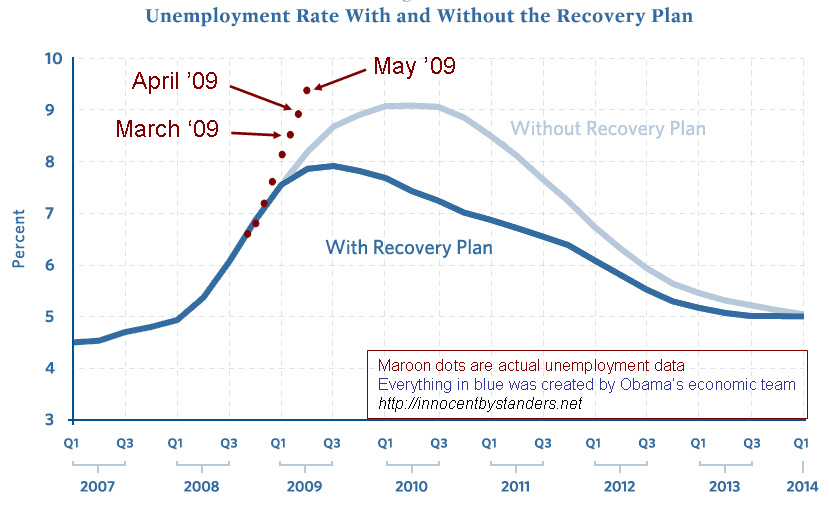
I recently posted The Graph, but this one from Small Dead Animals may be even better. The light blue line is what Obama said would happen to employment if we did nothing (my preferred option). The dark blue line is what Obama said would happen if we spent a trillion dollars on his economic policies. The maroon dots are what we actually got for our trillion dollars. The question to me is whether this is a case of incompetence or a calculated deception designed to use the poor economy as a excuse to foist drastic liberal policy upon the American people.
Wednesday, June 10, 2009
Teenagers are Morons
Ben Shapiro takes on the proposition that adolescents are capable of making informed choices on subjects ranging from sex to abortion to pot smoking:
There’s only one problem: science shows that adolescents simply don’t have the brains to use condoms. Literally. According to virtually all scientific studies concerning adolescent neural mechanisms, teens are biologically incapable of inhibiting risky behavior. “(T])e major sources of death and disability in adolescence are related to difficulties in the control of behavior and emotion,” explains Ronald E. Dahl, Staunton Professor of Psychiatry and Pediatrics at the University of Pittsburgh Medical Center. Although adolescents’ brains have developed enough to allow them the capacity to reason better than children, adolescents are biologically driven toward risky behavior and sensation-seeking by their functionally mature limbic systems. And the part of the brain that generally controls such risky behavior -- the prefrontal cortex -- is not yet fully developed. In other words, despite the fact that teenagers are smart enough to recognize the dangers of risky behavior, their brains ignore the risks when things get hot. Thus, teenagers are morons.More on this from EurekAlert!:
Researchers at the University of Illinois have found that adolescence is a time of remodeling in the prefrontal cortex, a brain structure dedicated to higher functions such as planning and social behaviors...This reinforces my notion that the voting age should be increased to 25.
Earlier studies in humans have found gradual reductions in the volume of the prefrontal cortex from adolescence to adulthood, said psychology professor and principal investigator Janice M. Juraska. "But the finding that neurons are actually dying is completely new. This indicates that the brain reorganizes in a very fundamental way in adolescence..."
These findings challenge current models of brain development by showing that some parts of the brain are still being organized well after puberty."We always think that having more neurons is better, and it might not be," Juraska said. In some stages of early child development up to half of the neurons in some brain regions are lost. The pruning away of unneeded or disruptive neural circuits appears to be as important to development as the growing of new neural connections, Juraska said.
Although other researchers had seen reductions in the size of the cortex, "no one thought neurons were lost, unless some terrible thing were happening," Juraska said. "Now we are seeing that some major changes are occurring in adolescence that no one has suspected."
Collective Amnesia
Walter Williams:
According to latest Rasmussen Reports, 30 percent of Americans believe congressmen are corrupt. Last year, Congress' approval rating fell to 9 percent, its lowest in history. If the average American were asked his opinion of congressmen, among the more polite terms you'll hear are thieves and crooks, liars and manipulators, hustlers and quacks. But what do the same people say when our nation faces a major problem? "Government ought to do something!" When people call for government to do something, it is as if they've been befallen by amnesia and forgotten just who is running government. It's the very people whom they have labeled as thieves and crooks, liars and manipulators, hustlers and quacks.
The Graph
This graph of the national debt has been popping up all over the place, and I might as well join the chorus as I'll probably be referencing it at some point. Obama's reckless spending makes the Bush's fiscal policies he constantly railed against seem, well, conservative by comparison. It's not hard to see the audacity of Obama. On every issue, it seems, his deeds belie his words. Change, indeed. Hope? No so much.

Update: The labeling on the graph is vague. I made a small change to my text to clarify that the graph is tracking the national debt.
Update: The labeling on the graph is vague. I made a small change to my text to clarify that the graph is tracking the national debt.
Sunday, June 7, 2009
Face lift
I spent the past few days checking out Wordpress, just to see how it compares to Blogger. On the whole I find the Wordpress interface more elegant and enjoyable to use, enough so that I came close to relocating Mental Hiccups. Unfortuately, none of the Wordpress canned themes is quite what I'm looking for, and they can't be modified without paying a fee. I don't blog enough to justify that expense, so a Blogster I remain.
The field trip to Wordpress did motivate me to start fiddling around with my site design here at Blogger, however. My CSS skills are very basic, so it's slow going, and there will likely be some design issues as I move forward. But hopefully I'll close in on a better look than the one I've been using before my inspiration runs out.
The field trip to Wordpress did motivate me to start fiddling around with my site design here at Blogger, however. My CSS skills are very basic, so it's slow going, and there will likely be some design issues as I move forward. But hopefully I'll close in on a better look than the one I've been using before my inspiration runs out.
Subscribe to:
Posts (Atom)