Thursday, July 30, 2009

Newsflash: Government wastes money

The Heartland Institute:
A 2007 study by the National Taxpayers Union Foundation found heavily subsidized stadium projects were significantly more expensive on average than largely privately funded projects. The study found stadiums where taxpayers bore a majority of the cost were $65 million more expensive on average than those for which private entities paid the bulk of the tab.
Not at all surprising. Private enterprises are motivated by profit, so they have a strong incentive to keep costs under control. Any time the government gets involved the priority becomes appearances and vote-getting.

[h/t John Hood]

Avoiding the traps in health care reform

Mary Katherine Ham highlights a video of Rep. Paul Ryan (R-WI) making the case against Obamacare. Ryan's does a great job, remaining on point and offering supporting facts, and leaves his opponents looking clueless. The video is definitely worth a watch.

That said, I have two problems with Ryan's statements at about the 1:15 mark. First, he embraces the goal of getting everyone insured. Studies show that many Americans are uninsured simply because they choose not to be. Millions can afford health insurance and elect not to purchase it. Millions more qualify for existing programs and choose not to participate. Whatever the reasons, it's not the government's job to make sure everyone has health insurance, and people shouldn't be forced into programs they don't want or feel they don't need.

Second, Ryan suggests that pre-existing conditions should be covered by the new insurance. This is "insurance after the fact," which means it's not insurance at all, but rather a form of wealth redistribution. If I wait until my house burns down to buy fire "insurance," I shouldn't expect my neighbors, who have been paying premiums all along, to compensate me for my loss on the grounds that it was a "pre-existing condition." Any reasonable person who thinks this through will realize that it's unfair and unworkable and that health insurance premised on this notion is equally unfair and unworkable.

Unfortunately, we're being encouraged not to think things through and to just accept the "free" candy we're being offered, and even those who oppose the move toward unsustainable socialism can fall into the trap.

[h/t Mark Hemmingway]

Wednesday, July 29, 2009

Thomas Sowell's three questions

As I follow the debates over health care and the economy, I'm continually reminded of a Thomas Sowell's observation:
Two questions would destroy at least half the agenda of the political left: "Compared to what?" and "At what cost?"

A third question would wipe out most of the rest of the left's agenda and demolish the vision behind that agenda: "What hard evidence do you have?"
I came across this Sowell formulation back in 2004. I find it to be very powerful in clarifying a wide range of issues.

The racial tipping point

A new study finds that Blacks tip 20 percent less, on average, than Whites.

Now that we've "evolved" to the point where the bulk of modern racism comes from Blacks and is directed at Whites, I take a bit of enjoyment in gratuitously pointing to these kinds of things. Speaking truth to power makes me feel superior, I guess.

Questioning Obamacare

Dennis Prager has 10 questions for supporters of Obamacare.

Tuesday, July 28, 2009

Economic thoughts

Excerpts from an interview with economist Guy Sorman:
Economics is always a matter of trade-offs: higher taxes will slow growth, but they can increase equality through wealth redistribution. This has been the dominant European model. If the U.S. opts for more wealth redistribution, we will get less growth. We can’t have it both ways, because resources are scarce.
So do the poor benefit more from the redistribution of wealth or from overall economic growth? Comparing the poor of today with the poor of previous generations, it's easy to see that today's poor are better off. They live longer, have better health care, and typically own cars, color televisions, VCRs, microwaves, cell phones, and a host of other devices yesterday's rich could only imagine.

It's also clear that today's poor owe their much improved circumstances not to having been given rich people's money, but to the innovations and technologies created and developed by those rich people. The rich, who are so often scorned in our society, should instead be celebrated. They are the heroes who -- albeit for selfish reasons -- have made available the many items which improve our lives at prices that even the poor can afford.
Obama’s success has been not to follow the most radical suggestions of liberal economists like Paul Krugman: advocating even more public spending, more nationalization of industries, and more regulation. All of Obama’s decisions, though, are half-baked: as a consequence, the U.S. may not be turning socialist, but it is becoming unpredictable.
Unpredictability kills growth. People are hesitant to spend and invest and expand when they don't have a sense of what's to come. They delay decisions, tighten up, and wait to see what develops. They only real way to climb out of a recession is to grow the economy, which means the increased uncertainty Obama has introduced into an already bad economy will only make things worse. And the poor get hit the hardest, since economic growth is the engine which drives the things which improve their lot.
The intelligentsia does not usually like the free market for two reasons. First, it is not an ideal system: intellectuals prefer utopia. Second: intellectuals are paid less than entrepreneurs. As a consequence, they see capitalism as unfair. In former socialist regimes, intellectuals were well treated when they toed the party line. If they didn’t, they were jailed.
Letting the perfect be the enemy of the good is one of the key flaws in modern liberal thinking. Capitalism is imperfect. Charter schools are imperfect. The free market is imperfect. It's easy to find flaws in any of these policies, but the evidence shows that these flawed policies work better than the alternatives. Shouldn't we be asking ourselves what works best rather than rejecting ideas simply because they aren't perfect?

Republicans go to school on Obamacare

Byron York:

Pick your average member of the House of Representatives, one who has a lot of work to do but hasn't been deeply involved in crafting the massive health care makeover bill. Who knows more about what's in that bill -- Mr. Average Democrat, or Mr. Average Republican?

Bet on the Republican. For weeks now, GOP lawmakers have been studying the Democratic health care bill, and for months before that, they studied preliminary Democratic plans. Many rank-and-file Democrats, on the other hand, have been so ill-informed about what their leadership has been doing that it was only last week, when the party offered a five-hour class on the bill's contents, that some members began to grasp the details.

That means the Republicans hold an advantage going into the health care ground war that will unfold during the August recess, when lawmakers go home to visit with voters. "We learned from the stimulus, and the other side didn't," says one savvy GOP aide. "They pushed through a bill as fast as possible so that no one knew what was in it. Very early on, there was a clear goal that Republican members of Congress would know what was in this [health care] bill and what its impact would be."

The cynic in me recognizes that this is mostly driven by political considerations, but the thought of legislators actually being informed on a issue they will be voting on is refreshing. Sad, that.


Monday, July 27, 2009

Jolt or no jolt: Biden versus Biden

Mark Silva calls attention to this quote from Joe Biden's recent op-ed in the New York Times: "The [economic recovery] act was intended to provide steady support for our economy over an extended period -- not a jolt that would last only a few months."

Unfortunately for Joe Biden, we have the Internet:

As recently as June, at a roundtable in New York, Biden called the Recovery Act "an initial big jolt to give the economy a real head start.''

In March, the vice president said ''the Recovery Act, as we call it, provides a necessary jolt to our economy to implement what we refer as 'shovel-ready' projects.''

And in November, as a new White House in planning was assembling its new economic team, President-elect Barack Obama said: "The most important thing to recognize is that we have a consensus, which is pretty rare, between conservative economists and liberal economists, that we need a big stimulus package that will jolt the economy back into shape and that is focused on the 2.5 million jobs that I intend to create during the first part of my administration. We have to put people back to work.


Sunday, July 26, 2009

CBO continues to discredit Obamacare

Politico:

For the second time this month, congressional budget analysts have dealt a blow to the Democrat's health reform efforts, this time by saying a plan touted by the White House as crucial to paying for the bill would actually save almost no money over 10 years.

A key House chairman and moderate House Democrats on Tuesday agreed to a White House-backed proposal that would give an outside panel the power to make cuts to government-financed health care programs. White House budget director Peter Orszag declared the plan "probably the most important piece that can be added" to the House's health care reform legislation. But on Saturday, the Congressional Budget Office said the proposal to give an independent panel the power to keep Medicare spending in check would only save about $2 billion over 10 years- a drop in the bucket compared to the bill's $1 trillion price tag.

"In CBO's judgment, the probability is high that no savings would be realized ... but there is also a chance that substantial savings might be realized. Looking beyond the 10-year budget window, CBO expects that this proposal would generate larger but still modest savings on the same probabilistic basis," CBO Director Douglas Elmendorf wrote in a letter to House Majority Leader Steny Hoyer on Saturday.

Friday, July 24, 2009

Time to decide what we want America to look like

I left this comment in response to an article on health care reform on Betsy's Page:
It should be infinitely obvious to anyone paying attention that the arguments being made for "health care reform" are a ruse in a top hat. It will raise, not lower, costs, and it will necessarily result in lower quality care. The CBO analysis is simply the latest confirmation of what we already know.

It's long past time for those who support Obamacare to abandon the specious arguments about spending less and receiving more.

The truth is they want everyone to have health insurance, and they believe the increased costs to others are moral and justified. The truth is that they are comfortable with the government assuming control and management of large swaths of our lives.

These are the arguments they should be making, and they are honest and well intentioned. Those who oppose these notions, whether on moral, economic, or libertarian grounds, are also honest and well intentioned.

This is the honest debate we should be having. It is fundamental to this and many other important issues. It's time to decide what we want America to look like.

Thursday, July 23, 2009

What's that about change again?

A commenter @ Althouse:
Obama is different and much worse than Bush. I cannot think of one area policy where Obama hasn't either followed the Bush lead or proposed something much worse. Where Bush gave us Part B, Obama gives us full up socialized medicine. Where Bush gave us 500 billion deficits, Obama gives us two trillion dollar deficits. Where Bush gave us TARP I, Obama gives us more TARP and the $700 billion porkulus package to boot.

Oh, but it is all worth it because Obama was going to close GUITMO, pull out of Iraq, give us an exit strategy in Afghanistan, stop warrantless wiretapping, repeal the Patriot Act, solve the Iranian problem and end the war on terror. How is that working out?
Yep, exactly. I'm increasingly baffled by people who continue to worship this president.

Obamacare could cost more than 4.5 trillion

I recently read that Medicare costs about ten times as much as the Congressional Budget Office estimated it would. This result is in keeping with the CBO's track record on spending estimates -- i.e. not very good. So I wasn't at all surprised to read that the cost of Obamacare might top $4.5 trillion ($4,500,000,000,000).

The House version of the health care reform bill proposes a payroll tax on those firms that are not providing workers with health care. The tax varies by payroll size, reaching a top rate of 8 percent, but the rate is much lower for the smallest businesses.

For an outfit with a payroll of less than $250,000, the tax is zero. Clearly, firms facing no tax, as well as others, would prefer this subsidized or no-cost government insurance to private plans. As many small firms switch from private plans to low or no cost, taxpayers will foot the bill.

Perhaps CBO underestimated how many small businesses there are or how many workers are employed by such firms. The Census Bureau shows that firms with fewer than 10 employees have an average payroll of just $91,000. Firms with fewer than 10 employees employ 12.3 million people and pay $18.5 billion a year in health insurance, which amounts to the substantial sum of $185 billion over 10 years. Most, if not all, firms in this category would want to switch to the no-cost government health plan because they would be freed from these billions in insurance fees.

This single example implies that the cost of health care change is almost 20 percent higher than CBO claims. But that is just part of the tab. There are surely many smaller firms that would want to switch to low-cost government insurance.

CBO -- incredibly -- assumes that only 3 million people will switch from employer-provided coverage to government insurance. But the Lewin Group, a health care policy research and management consulting firm, estimates that 119 million Americans will switch from their current private insurance to government insurance. If these figures are accurate, the program's cost could easily be $4.5 trillion over 10 years, not the $1.04 trillion CBO is claiming. That new financial burden would be a disaster for the deficit.

I thought this plan was supposed to save us money.

Update: I said above that I recently read that Medicare ended up costing about ten times what was estimated. I'm pretty sure I'm remembering that right, but I don't have a link. John Stossel writes today: "In 1965, hospitalization coverage under Medicare was projected to cost $9 billion by 1990. The actual price tag was $66 billion. " I don't know if he's looking at the same parameters as the stat I'm recalling, but even his lower numbers make the point.

Paving the road for middle class tax increase

Kevin Williamson @ The Corner notes President Obama laying the ground work for a broken promise:
That didn't take long. Remember when Obama promised no middle-class tax increases? The weaseling begins!

WASHINGTON – Six months in office, President Barack Obama sought to rally support for sweeping health care legislation Wednesday night as Congress struggled to find agreement on a historic overhaul. He vowed to reject any measure "primarily funded through taxing middle-class families."

"Primarily"? How many dump-trucks full of middle-class taxpayers' revenue can you drive through that loophole?

Anyone who has been watching (as opposed to listening to) Obama has seen this coming for months, what with taxes on gasoline, soda, beer, juice, tobacco, electricity, etc. being bandied about.

Tearng the health care myths down

Dr. Clifford Asness breaks down many of the prevalent myths surrounding the push for socialized medicine. A good article to keep on hand as these specious arguments are continually recycled.

Wednesday, July 22, 2009

Obama's popularity

According to a USA Today/Gallop poll:
At six months in office, Obama's 55% approval rating puts him 10th among the 12 post-World War II presidents at this point in their tenures. When he took office, he ranked seventh.

Friday, July 17, 2009

"Lowering health care costs" will cost us trillions

Washington Post:

Under questioning by members of the Senate Budget Committee, Douglas Elmendorf, director of the nonpartisan Congressional Budget Office, said bills crafted by House leaders and the Senate health committee do not propose "the sort of fundamental changes" necessary to rein in the skyrocketing cost of government health programs, particularly Medicare. On the contrary, Elmendorf said, the measures would pile on an expensive new program to cover the uninsured.

Though President Obama and Democratic leaders have repeatedly pledged to alter the soaring trajectory -- or cost curve -- of federal health spending, the proposals so far would not meet that goal, Elmendorf said, noting, "The curve is being raised." His remarks suggested that rather than averting a looming fiscal crisis, the measures could make the nation's bleak budget outlook even worse.

The whole idea that handing over health care decisions to the government will lower costs is absurd. Conservatives know it; liberals know it; everyone knows it. That's why Obama is pushing so hard to get his plan through Congress before August -- before the public catches on -- just as he did his "stimulus" plan, his massive budget increases, and his "cap and trade" energy tax.

Anyone who watches the news has to wonder why "cost saving," "revenue neutral" health care "reform" is expected to cost over $1,000,000,000,000. A trillion dollars is a bit more expensive than "saving us money." Which is why we see dozens of proposals for new ways to raise taxes -- on soft drinks, alcohol, employer-provided health care, gasoline, electricity, and a host of other things, including the imposition of a national sales tax. So much for Obama's promise that 95% of Americans won't see a tax increase.


Obama's false promise about health care reform

Betsy McCaughey of the New York Post puts the lie to President Obama's claim that those who like their current health care plan will be able to keep it if his health care plan passes:

PRESIDENT Obama promises that "if you like your health plan, you can keep it," even after he reforms our health-care system. That's untrue. The bills now before Congress would force you to switch to a managed-care plan with limits on your access to specialists and tests.

Two main bills are being rushed through Congress with the goal of combining them into a finished product by August. Under either, a new government bureaucracy will select health plans that it considers in your best interest, and you will have to enroll in one of these "qualified plans." If you now get your plan through work, your employer has a five-year "grace period" to switch you into a qualified plan. If you buy your own insurance, you'll have less time.

And as soon as anything changes in your contract -- such as a change in copays or deductibles, which many insurers change every year -- you'll have to move into a qualified plan instead (House bill, p. 16-17).

[h/t Betsy]

Thursday, July 16, 2009

Then and now

Karl Rove:

When it came to the stimulus package, the president and his administration promised, in the words of National Economic Director Larry Summers, "You'll see the effects begin almost immediately." Now it's clear that those promised jobs and growth haven't materialized.

So Mr. Obama is attempting to lower expectations retroactively, saying in an op-ed in Sunday's Washington Post that his stimulus "was, from the start, a two-year program." That is misleading. Mr. Obama never said if his stimulus were passed things might still get significantly worse in the following year. . . .

Earlier this year, Mr. Obama assured us that most of the stimulus money "will go out the door immediately." But it hasn't. Only about 7.7% of the stimulus has been spent in the six months since its passage, and more of it will be spent in the program's last eight years than in its first year. So now the president claims he said something different. "We also knew that it would take some time for the money to get out the door," Mr. Obama said in his weekly radio address on Saturday.

Wednesday, July 15, 2009

Fact checking and broken promise

A couple of items from PolitiFact.com. The first is a simple fact check:
In an interview with Novaya Gazeta , a Russian newspaper, President Barack Obama was asked what caused the economic crisis. Obama answered that oil imports were partly to blame.

"Our economy did not fall into decline overnight," he said in the July 6, 2009, interview. "We have known for decades that our survival depends on finding new sources of energy. Yet we import more oil today than ever before."

Obama said the same thing on February 24, 2009, during his first address to Congress.

But . . . crude oil and petroleum imports have actually declined in recent years after peaking in 2005 and 2006. . . .

In two decades, imported oil will be down by about 20 percent, according to a March 2009 EIA report.

And in April 2009, the American Petroleum Institute said that imports have fallen to their lowest levels in three years.
The second is a broken promise:

During the presidential campaign, Barack Obama said several times that he intended to negotiate health care reform publicly. In fact, he said, he'd televise the negotiations on C-SPAN, with all the parties sitting at a big table. That way, Americans would be more engaged in the process and insist on real change.

That's what I will do in bringing all parties together, not negotiating behind closed doors, but bringing all parties together, and broadcasting those negotiations on C-SPAN so that the American people can see what the choices are, because part of what we have to do is enlist the American people in this process. . . ."

I'm going to have all the negotiations around a big table. We'll have doctors and nurses and hospital administrators. Insurance companies, drug companies — they'll get a seat at the table, they just won't be able to buy every chair. But what we will do is, we'll have the negotiations televised on C-SPAN, so that people can see who is making arguments on behalf of their constituents, and who are making arguments on behalf of the drug companies or the insurance companies.

We were able to find four additional instances where he made the same promise during public appearances in 2007 and 2008. And in one case, he said he'd do it in his first 100 days.

[S]o far, substantial negotiations on health reform have been held behind closed doors. These include two agreements with the drug industry and hospitals to reduce costs over the next 10 years. In Congress, some of the committee bill writing sessions have been open, but negotiations are also taking place behind closed doors. That's routine in Congress. Much of the difficult negotiations take place in private sessions, before bills come to committee or the House or Senate floor.

Tuesday, July 14, 2009

The National Debt Road Trip

This YouTube video, conveying the history of our national debt in everyday terms, is brilliantly effective.

Sunday, July 12, 2009

Continued cloudiness, with a chance of rain

As a follow-up to my earlier post:

Jonathan Adler:
A few weeks ago, the Obama Administration officially abandoned the President's "Sunlight before Signing" campaign pledge that the White House would post all legislation passed by Congress for at least five days before the President would sign it. In making this announcement, the Administration maintained that it would comply with the spirit, if not the letter, of the original commitment by posting legislation on the White House site once it became clear legislation would eventually pass and make it to the President's desk. This new commitment, they suggested, would actually provide even greater sunlight, as some bills would be available for review earlier and for a longer time. Well, this promise is no longer operative either, as the Cato Institute's Jim Harper details. Since the White House announced its new sunlight policy, nine additional pieces of legislation have been signed into law by the President and yet, as of yesterday, not one had been posted on the White House web site.

Saturday, July 11, 2009

Debating the Sotomayor nomination

The Federalist Society is sponsoring an ongoing online debate about Sonia Sotomayor's nomination to the Supreme Court.

[h/t Instapundit]

Friday, July 10, 2009

Obama's Version of "Read My Lips"

The Heritage Foundation:

Throughout his campaign President Barack Obama repeatedly promised the American people: “If you’re a family that’s making $250,000 a year or less you will see no increase in your taxes. Not your income tax, not your payroll tax, not your personal gains tax, not any of your taxes.” Just 15 days into office, President Obama signed a bill expanding Medicaid eligibility that was paid for with a 156% tax hike on tobacco. Since slightly more than half of today’s smokers (53%) earn less than $36,000 per year, Obama’s first effort at expanding government’s role in health care also became his first broken promise. But that first Medicaid expansion was minor league compared to the estimated $1.5 trillion health care plan Congress is considering now.

And how does Congress plan on paying for this $1.5 trillion in new spending. Tax hikes. Some of these tax hikes even conform to Obama’s promise. They only punish our most productive workers and investors. Proposed tax hikes in this category include: 1) capping the value of itemized deductions including gifts to charities; 2) a 3% surtax on households earning more than $250,000; and 3) a millionaires tax.

But the left is beginning to figure out that you can only squeeze so much revenue from class warfare taxation. So Congress is also considering a slew of other taxes that will, again, force Obama to break his not tax hike promise. These include: 1) a tax on soda; 2) a tax on beer; 3) an increase in employer and employee payroll taxes; 4) a flat tax on health insurance companies; 5) broaden the Medicare tax on investment income; 6) an employer mandate; and 7) a value added tax on everything but food, housing, and Medicare. And we’re sure we missed some. The left sure can be creative when they are desperate to raise revenue.
So, no tax increase on 95% of Americans . . . except for all those, um, taxes. I wonder if this will get as much coverage as Bush 41's "read my lips" pledge. No wait, I don't.

Today's Presidential Forecast: Mostly Cloudy

From barackobama.com:
Sunlight Before Signing: Too often bills are rushed through Congress and to the president before the public has the opportunity to review them. As president, Obama will not sign any non-emergency bill without giving the American public an opportunity to review and comment on the White House website for five days.
Jim Harper: "At this point, only one of 39 bills that the president has signed has been posted for five days in advance. "

Update [7/12/09]: More here.

Wednesday, July 8, 2009

The Cost of Preventive Medicine

Yuval Levin:
There are now literally decades of data on this question, and the answer is very clear: prevention does not save money. It does sometimes save lives, of course, it’s not bad medicine. It’s often very good medicine. But like a lot of good modern medicine, it’s very expensive. We can decide if it’s worth the cost or not, but let’s not ignore the cost, let alone imagine it will save us money.

The most recent serious scholarly review of the data on this question was an article in the journal Health Affairs earlier this year (here’s the link, but it requires a subscription). The author’s conclusion:

Over the four decades since cost-effectiveness analysis was first applied to health and medicine, hundreds of studies have shown that prevention usually adds to medical costs instead of reducing them. Medications for hypertension and elevated cholesterol, diet and exercise to prevent diabetes, and screening and early treatment for cancer all add more to medical costs than they save.

That doesn’t mean we shouldn’t pursue preventive medicine, it just means we shouldn’t pretend it’s going to reduce health care costs.

Where the Stimulus Money is Going

Stephen Spuriell:

James Pethokoukis links to a GAO report that surveyed 16 states and the District of Columbia to see how stimulus funds are being spent. The study found that 90 percent of the stimulus funds spent so far have gone toward bailouts for fiscally irresponsible state governments. These states made commitments on health care and education spending commensurate to what they could afford during the boom years. When the economy crashed and tax revenues dried up, they had no way to pay for these commitments short of raising taxes, which none of them wanted to do. (Most states' constitutions restrict their ability to run deficits.)

This is what the stimulus was really all about — not creating or "saving" jobs, but preventing states from suffering the consequences of their profligacy.

Monday, July 6, 2009

Journalistic Malpractice from George Stephanopoulos

George Stephanopoulos did a poor job of reporting on his recent interview with Joe Biden. He let a lot of Biden's false and misleading statements go unchallenged. It's one thing to let these statements slip by during a live interview; it's another to recycle them without correction in a written follow-up summary.

Stephanopoulos quotes Biden as saying, "The truth is, we and everyone else misread the economy."

No, the truth is that hundreds of prominent economists disagreed with President Obama's read on the economy and went on record advising against his massive "stimulus" package. It's irresponsible for Stephanopoulos to let Biden's statement to go unchallenged.

Stephanopoulos writes:

Biden acknowledged administration officials were too optimistic earlier this year when they predicted the unemployment rate would peak at 8 percent as part of their effort to sell the stimulus package. The national unemployment rate has ballooned to 9.5 percent in June -- the worst in 26 years.

Fair enough, but shouldn't Stephanopoulos have pointed out that the Congressional Budget Office (CBO) ran Obama's numbers and concluded that we'd be better off doing nothing than passing the "stimulus" plan?

Back to Biden:

We misread how bad the economy was, but we are now only about 120 days into the recovery package," he said. "The truth of the matter was, no one anticipated, no one expected that that recovery package would in fact be in a position at this point of having to distribute the bulk of money.

This is the part where Stephanopoulos should have pointed out that Obama spent weeks talking down the economy while trying to push his "stimulus" package through Congress. It's tough to buy the excuse that they didn't know how bad it was when they were daily throwing around words like crisis and catastrophe and describing this as the worst economy since the Great Depression.

Stephanopoulos should also have pointed out that one of the key criticisms opponents had of the "stimulus" package was that most of the "stimulus" wouldn't come until after the economy had recovered. In fact, the CBO concluded exactly that. For the administration to now say that it's too early to expect results because the bulk of the money hasn't been spent is pure humbug.

Remember, this is the bill Obama argued had to be passed immediately -- legislators weren't even given a chance to read it before they were forced to vote on it -- because any delay would be "inexcusable and irresponsible." Now that we aren't seeing the results they promised, it's become convenient to admit that the bill that couldn't be delayed doesn't really do much for the first year.

I don't know whether bias, laziness, or incompetence is to blame for Stephanopoulos not doing his job, but it's obvious that he didn't do it. The whole "we report; you decide" approach to journalism is damaging the country. It's a journalist's job to provide context and basic fact checking. If they won't do that, what good are they?

Saturday, July 4, 2009

Exploding Health Care Costs

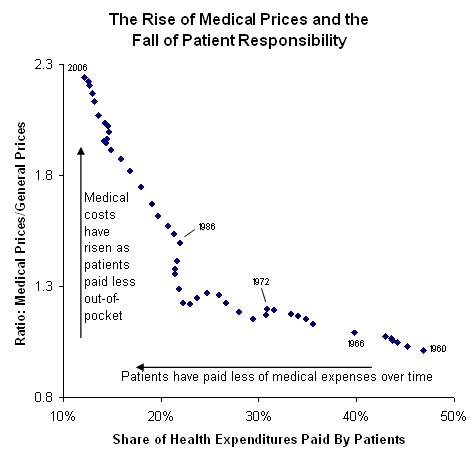
I've been posting a lot of graphs lately, because they show so clearly what's going on with various aspects of the economy. Here's another, from the Goldwater Institute (via John Stossel), which shows health care cost skyrocketing as patients pay a diminishing share of those costs.

Updated Unemployment Graph

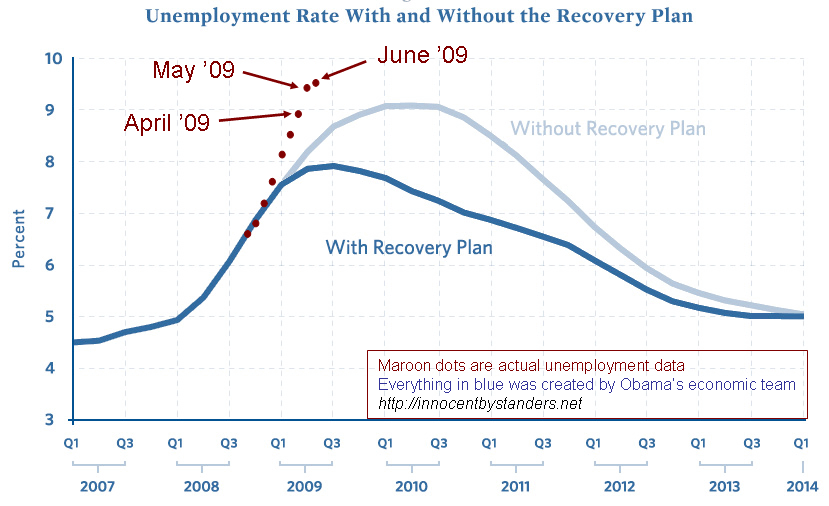
I posted an earlier version of this graph a while back. The good news is that there has been a slowing of job losses. The bad news remains that unemployment continues to track at a much higher rate than President Obama said it would without his stimulus package.

Friday, July 3, 2009

Re-analyzing the housing crisis

Stan Liebowitz says the accepted explanation of what caused the housing crisis is wrong and that, therefore, our approach to solving it is also wrong:
What is really behind the mushrooming rate of mortgage foreclosures since 2007? The evidence from a huge national database containing millions of individual loans strongly suggests that the single most important factor is whether the homeowner has negative equity in a house -- that is, the balance of the mortgage is greater than the value of the house. This means that most government policies being discussed to remedy woes in the housing market are misdirected.

Many policy makers and ordinary people blame the rise of foreclosures squarely on subprime mortgage lenders who presumably misled borrowers into taking out complex loans at low initial interest rates. Those hapless individuals were then supposedly unable to make the higher monthly payments when their mortgage rates reset upwards.

But the focus on subprimes ignores the widely available industry facts (reported by the Mortgage Bankers Association) that 51% of all foreclosed homes had prime loans, not subprime, and that the foreclosure rate for prime loans grew by 488% compared to a growth rate of 200% for subprime foreclosures. . . .

[T]he most important factor related to foreclosures is the extent to which the homeowner now has or ever had positive equity in a home. . . . A simple statistic can help make the point: although only 12% of homes had negative equity, they comprised 47% of all foreclosures.